How to Keep a Steady Beat
Try a 12-tap exercise, read four timing patterns, and learn what to change when you rush, drag, or lose the beat.
Perceptle7 min read
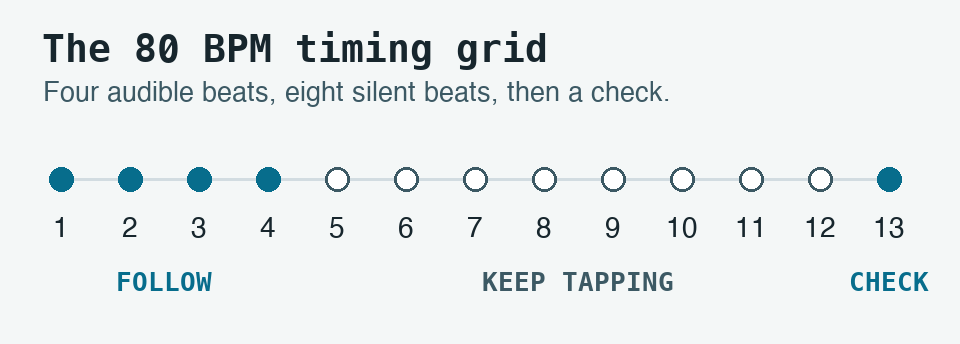
If you’re learning how to keep a beat after the clicks stop, start by spacing your taps evenly. Start at 80 beats per minute and tap with four metronome clicks. Keep tapping for eight silent beats. When the click comes back, listen for whether your tap lands ahead of it, behind it, or with it.
Try the 12-tap exercise
Pick one sound or movement you can repeat easily. A finger on a desk works. So does a quiet clap. Play the track and tap every beat while counting 1, 2, 3, 4 in your head.
- Follow four audible beats. Tap once on each click. Let the sound establish the spacing before you try to predict the next one.
- Keep going for eight silent beats. Continue at the same pace without waiting for the sound. Count two more groups of four.
- Meet the returning click. It lands on beat 13. If you hear your tap before the click, you arrived early. If the click comes first, you arrived late. That final comparison tells you where you ended. The gaps between taps show how you got there.
With your own metronome, keep its clock running while you mute and unmute the sound. If muting takes too much attention, use the track here. If you want to inspect individual gaps, record the clicks and your taps together, then look at the spacing between tap peaks in the waveform.
Beat, tempo, and rhythm
The beat is the pulse you can tap to. Tempo is the speed of that pulse. Rhythm is the pattern of sounds and rests that can sit on or between the beats. A syncopated melody can sound busy even while the underlying tempo stays steady.
A metronome set to 80 BPM puts 80 beats in 60 seconds. Divide 60,000 milliseconds by 80 to get 750 ms per beat.
| Tempo | Time between beats |
|---|---|
| 60 BPM | 1,000 ms |
| 80 BPM | 750 ms |
| 100 BPM | 600 ms |
| 120 BPM | 500 ms |
If a long gap is hard to hold, count 1 & 2 & 3 & 4 & silently. The & splits the gap in half. At 80 BPM the halfway point is 375 ms, but your taps still land 750 ms apart, on the numbers.
How to tell what went wrong
There are two questions to ask about a recording. Where did each tap land relative to the reference? And how long was the gap to the next tap? The first tells you whether a tap was early or late. The second tells you whether your pace held steady.
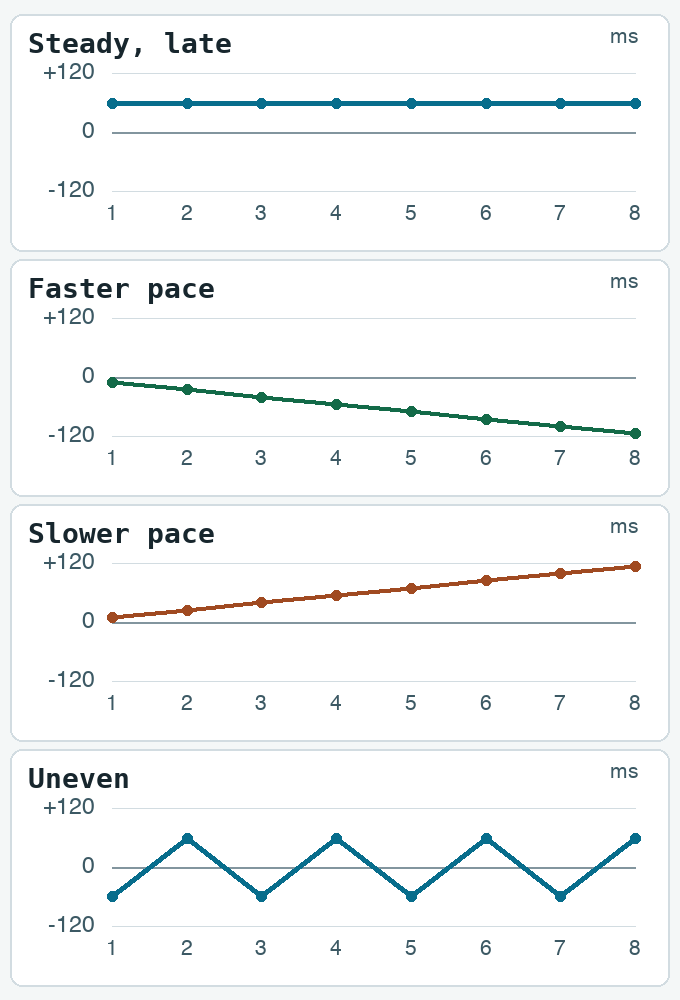
These four examples use the same 80 BPM reference. Each dot is one of the eight silent taps. The zero line is a tap that lands exactly on its reference beat. Positive values are late, and negative values are early.
| Pattern | 1 | 2 | 3 | 4 | 5 | 6 | 7 | 8 |
|---|---|---|---|---|---|---|---|---|
| Steady, late | +60 | +60 | +60 | +60 | +60 | +60 | +60 | +60 |
| Faster pace | −10 | −25 | −40 | −55 | −70 | −85 | −100 | −115 |
| Slower pace | +10 | +25 | +40 | +55 | +70 | +85 | +100 | +115 |
| Uneven | −60 | +60 | −60 | +60 | −60 | +60 | −60 | +60 |
| Pattern | Gaps between taps | Mean offset | Drift | Jitter |
|---|---|---|---|---|
| Steady, late | 750 ms | +60.0 ms | 60.0 ms | 0.0 ms |
| Faster pace | 735 ms | −62.5 ms | 62.5 ms | 34.4 ms |
| Slower pace | 765 ms | +62.5 ms | 62.5 ms | 34.4 ms |
| Uneven | 630 / 870 ms | 0.0 ms | 0.0 ms | 60.0 ms |
Look first at the two sloping lines. The gaps in the faster example are always 735 ms. Each gap is 15 ms shorter than the reference, so the taps get progressively earlier even though the tapping speed itself stays fixed. If the gaps also get shorter from one tap to the next, the player is still speeding up. The slower example works the same way in the opposite direction. Its drift and jitter are identical to the faster example, which is why the direction of the line matters.
Now compare the two flat-in-average cases. The consistently late taps preserve the correct 750 ms spacing. The alternating taps average out to zero, but their gaps alternate between 630 and 870 ms. A near-zero mean can hide uneven playing.
Fix one problem at a time
| What you notice | What to check | What to try next |
|---|---|---|
| Every tap is early or late by about the same amount | Listen to the transition into the first silent beat. The remaining gaps may already be even. | Keep the same grip and movement through the transition. Start with two silent beats, then check alignment. |
| You get farther ahead or behind on each tap | Compare successive gaps with the metronome interval. | Count the halfway points silently. Try four silent beats before going back to eight. |
| You bounce around the beat | Look for alternating short and long gaps. | Keep your tap small and even. Shorten the silence, then add beats once the gaps are more consistent. |
Keep the tempo and the kind of tap fixed for two tries. First record what you do naturally. Then pick one change from the table and listen again. Compare the same cue and the same number of silent beats. Once you can continue for eight beats at that setting, try a different tempo. A slower setting leaves more space to fill, so it can be a different kind of challenge.
A full Perceptle Tempo round, annotated
In a regular Perceptle Tempo round, four valid taps with the metronome establish your timing. The clicks stop and you tap eight times on your own. The return cue in this article is part of the practice track. The game shows your timing in the reveal after the eighth independent tap.
Read the video walkthrough
The game shows the target speed of 110 BPM. Four metronome clicks sound while the player taps along. The sound stops, and the player continues for eight taps. The reveal shows eight late taps and reports 59 ms drift and 29 ms jitter.
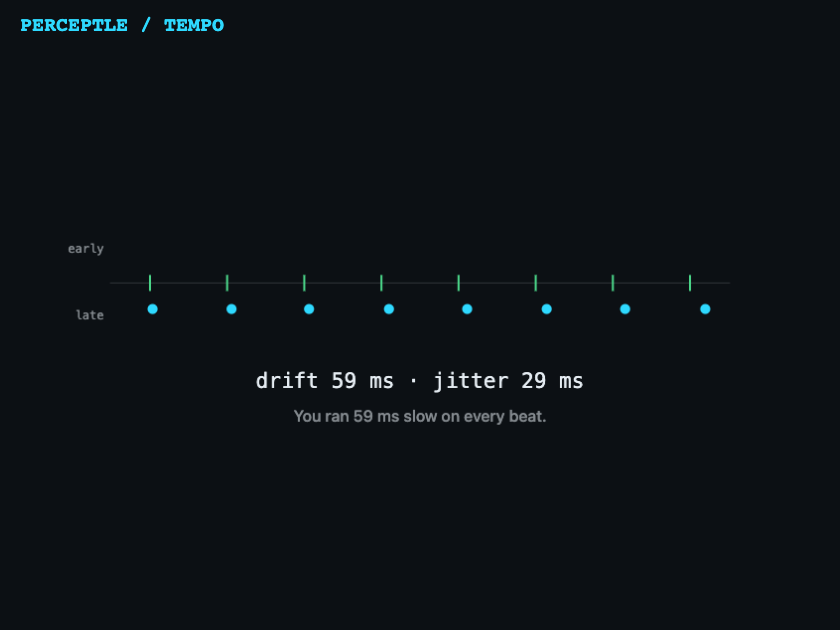
The game uses the first four taps to account for a consistent delay in your setup. It handles shifts of a whole beat separately. Drift is the magnitude of your average timing offset after those adjustments. Jitter describes how much the individual offsets vary around that average. The sign on the graph tells you which way you missed. In the two sloping examples above, the same numeric drift and jitter describe very different directions.
Questions that come up when you practice
Can I practice without a metronome?
Yes. Tap with a song that has a clearly audible beat, mute it for a few beats, and bring it back while it is still running. A metronome is convenient when you want a known interval and a repeatable check.
How can I tell if I am speeding up?
Record your taps and compare the gaps. If each tap gets earlier against the reference but the gaps stay equal, you are holding a faster pace. If the gaps themselves keep shrinking, you are accelerating.
Can I train my sense of rhythm?
Use a repeatable tap exercise to practice the specific skill you want. At one tempo, alternate between listening and tapping through silence. Compare your own recordings at the same BPM to see whether the gaps became more consistent on that exercise.
How we made the examples
The four curves use constructed tap sequences at 80 BPM. We passed the inputs through Perceptle’s normal Tempo measurement so the plotted offsets and the table use the game’s definitions. Summary values are rounded to one decimal place. These sequences illustrate different timing patterns. The video shows a separate recorded run using scripted input so the taps and reveal can be checked.
The listen-then-continue procedure is also used in rhythmic tapping research, where it is called a synchronization-continuation task. The Perceptle project notes link to research on this setup.
Practice again
Pick the drill that matches your recording and try the same tempo once more. When you are ready to apply it in a game, Perceptle Unlimited gives you a fresh five-round set that includes Tempo.